
Harm Thine Enemy
...and help your friends: Ancient Greece's Golden Rule.

The whole of Greek antiquity thinks differently from us about hatred and envy. … What a gulf of ethical judgment lies between us and him!
—NIETZSCHE
Did they really think so differently, the Greeks from us—we who must love every civilisation except our own and hate none but ourselves? To measure the width of any gulf between Greek antiquity and Western modernity we need to find Ancient Greece’s central imperative.
We need to find its Golden Rule…
The Christian Golden Rule we (most of us) know. It’s taken from two of Jesus’ sermons, one given on a hill, one on a plain. In Matthew the Nazarene says:
In everything, do to others what you would have them do to you, for this sums up the Law and the Prophets.
While on flat ground in Luke he says:
Do to others as you would have them do to you.
Well that was easy. ‘I would like somebody to give me $5,000. Therefore I’m going to give somebody $5,000.’ And practical too. On an individual level it’s seldom an impetus to charity though, and most often a motive for busybodies and know-it-alls. On an international level it’s an excuse for interventionists and a recipe for disaster: ‘I would like to be rid of my undemocratic government, therefore I’ll go and rid those people of theirs.’
When we retreat a few decades to Judaism we find that not long before Jesus of Nazareth was beatitudising, from about 30BC to 10AD one Hillel was the leader of Jerusalem’s Jewish community. One day, Hillel was asked by a heathen to teach him the whole Torah while that heathen stood on one foot. Hillel dismissed him:
What is hateful to you, do not do to your neighbour: that is the whole Torah, the rest is commentary.
So we have a negatively formulated Golden Rule—‘do NOT do’ rather than ‘DO’—and we’ll call that the Silver Rule. The Silver Rule can be found in Confucius and in the Mahabharata and its sentiment underlies the inaction inherent in Buddhism and Stoicism—’my world is just fine as long as nobody does to me what I wouldn’t do to them.’ I don’t want to be harassed, therefore I will make it impossible for me harass anybody but retreating from the world entirely.
So we have a Christian Golden Rule and a slightly older Jewish Silver Rule—but what about an Ancient Greek Rule, a Bronze Rule? There’s nothing in the world except helicopters that didn’t exist in Ancient Greece, so surely they had their own simple ethical maxim by which every life should be lived. They invented philosophy; perhaps their metallic rule was, ‘Do not not do to others what you would not have them not not do to you.’ I’ve never come across such a formulation. So what was the ethical core of the Ancient Greek world—the one rule that summed up their Laws and their Prophets (though they generally laughed at prophets)?
If we look first, as always we should, at The Iliad we find a few contenders. Glaukus, fighting on the Trojan side of the war, recalls that his father taught him ‘always to be the best and to rise above others.’ But we can hardly expect Homer, even with his lack of hatred, to place his Golden Rule in the mouth of a non-Achaean. We look then to the Greek camp, and find the sage Phoenix giving advice to Achilleas:
Your father sent me to instruct you in both these things: to be both a speaker of words and a doer of deeds.
‘Always be the best, rise above others—and be both a speaker of words and a doer of deeds.’ Not quite a universal ethic, and we know that Homer dealt in aristocratic excellence, not behavioural universals. And although Achilleas does espouse honesty:
I hate that man like the very Gates of Death who says one thing but hides another in his heart.
Odysseus is a notorious deceiver—lies even to a ghost—and was celebrated for his deceptions. So we leave the really ancient Homer behind, and move on to the century after him and the Lyric Poets. To the 7th-century Archilochos it’s best to:
Take pleasure in what is pleasant, yield not overmuch to troubles, and understand the rhythm which holds mankind in its bonds.
Well that’s three rules, so for lack of focus we disqualify him. Next comes Theognis of Megara, who gives us the relaxing individualism of the second half of the 6th century:
To be just is the finest virtue; health is the most advantageous; but what one loves gives greatest delight.
We aren’t searching though for a fine virtue, nor for an advantageous one, nor for delight—and we find no Bronze Rule in Theognis. Actually so skeptical was he about Greek life that he opened a new strain in Greek thought:
Best of all for mortals were it never to have been born, nor to have seen the rays of the burning sun.
So it’s best of all for us not to listen to Theognis of Megara, but we find no advancement in the slightly later Simonides:
To be healthy is the best of all things, the second is a noble character, the third is wealth obtained without dishonour, the fourth to spend one’s youth with dear friends.
He’s rehashing his near-contemporary, and we’re not interested in anyone’s listicle of ancient Goods. What about the proud traditionalist Pindar then?
At the end of his first Pythian Ode, of 470BC, Pindar lists life’s greatest blessings. To live happily is the most desirable, a noble reputation the next most—and anyone who attains and keeps both is the possessor of the splendidest crown. Again! We’re ranking Goods, and—ignoring Herakleitos—not focusing on the one Good that threads all Good through other Goods.
So five Lyric Poets and two centuries have given us several suggested ends of life—delight, virtuousness, happiness—but no Golden, or rather Bronze Rule by which those ends should be attained. ‘Be healthy, well-respected, and rich’ is hardly an ethical guideline for interacting with our fellow humans. So let’s move on to Tragedy, and into the golden 5th century.
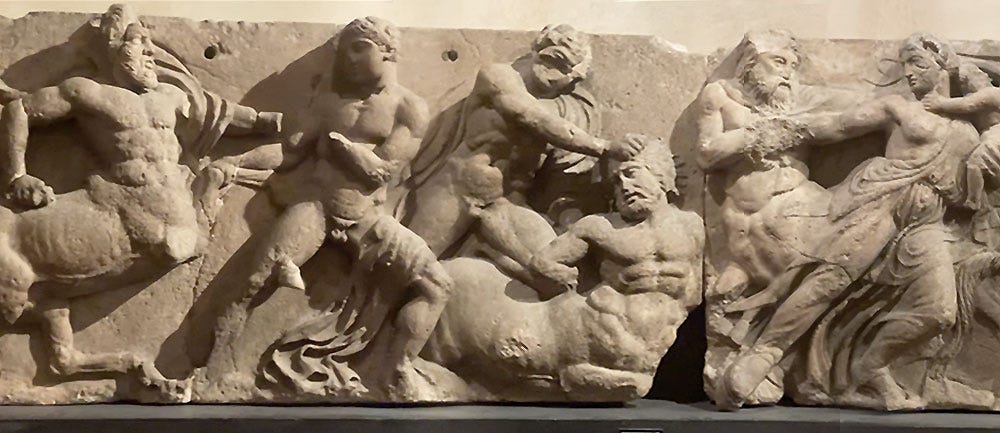
In 467 Pindar’s kindred contemporary Aeschylus listed four things that an ideal man ought to be: just, brave, righteous, wise. A century later Plato lists the same four ideal virtues—courage, wisdom, righteousness, prudence—but still! We have lists of virtues and not a single rule by which even the virtuous ought to live—no encapsulation of all of Greek thought—no summation of the Law or whole of Greek ethics. Rules we do find at Delphi though…
There were 150 Delphic Maxims, inscribed in or around the Temple of Apollo there, and three were held to be so important that they alone were inscribed on the temple’s entrance:
KNOW THYSELF; NOTHING IN EXCESS; SURETY PRECEDES RUIN.
2,000 years have not given agreement on the nature of the third Maxim. ‘Surety’ can refer to co-signing a loan, swearing a marriage vow, AND to being certain of something. Even Plutarch, who was from nearby Chaeronea and served as a priest of the very same Delphic Apollo , wrote that the third maxim kept many from marrying, many from trusting, and some even from speaking. And again, we have three rules rather than one—the third lost of meaning—and no shining shimmering Bronze Rule.
If we turn back to Aeschylus we find in his Suppliants another contending triad. His chorus expounds upon three divine and unchangeable laws of justice, and prays that they’ll stand forever. If we pare away the poetic language we find them to be:
Honour the gods; honour your parents; honour strangers.
Honour, honour, honour—and these Xenophon’s Sokrates called the Unwritten Laws, which some modern scholars call the Greek Commandments. But still and again: we have Virtues and Commandments but nothing to supersede or summarise them.
What then of our elusive Bronze Rule, our potential Χαλκονομος?
We find an early glimmer of such a thing in Homer, but not in Iliad. In Book VI of The Odyssey, Odysseus is praising the contentment of a married couple and describes their happiness as ‘great sorrow to their enemies and joy to those who love them.’ (He might have been lying though, to get out of a sticky situation or to deceive a ghost.)
But soon the early 6th-century Solon prays ‘to have ever good repute before all men, and so to be sweet to my friends and bitter to my enemies.’ If we follow this friend-enemy breadcrumb trail we can, after all, listen to Theognis of Megara—for in his advice to his young companions he tells us that as well as avoiding poverty at all costs, even at the cost of your life, he always prays that heaven might fall on him if ever he fails ‘in helping those who love me’ or in bringing his ‘enemies woe and pain.’
We have a pattern! And one that by 500BC might be becoming our Bronze Rule: ‘Bring sorrow, bitterness, woe and pain to your enemies—help those who love you and be sweet and give joy to your friends.’ Pindar too, if we read a second Pythian Ode, asserts among his several ethical proverbs:
Let me be a friend to my friend; but I will be an enemy to my enemy, and pounce on him like a wolf.
And about 20 years later the Athenian epitome Sophokles himself has Kreon tell his son that men pray for one thing above all else:
To sire and raise in their homes children who are obedient, that they may requite their father’s enemy with evil, and honour his friend, just as their father does.
So we have not only an ethical rule for oneself, but a rule that we pass to our children and the chief motivation for child-bearing—we exist not to pass on our genes, but to have the inheritors of our genes hurt our enemies and honour our friends. The jurisdiction of the Bronze imperative is growing! And it might be all-encompassing.
Ten years later again, Euripides says in his Medea:
Hurtful to foes, to friends kindly—such persons live a life of greatest glory.
And less than two decades after that, Aristophanes has two men from Greece-the-land-of-the-wise travel to the land of the birds, who inquire as to why they’ve come:
What can they possibly have to gain by staying with us? Will it help their friends or harm their enemies?
Our hastily bronzing rule is given as only conceivable motivation for doing something as crazy as leaving Athens for Birdland, as almost simultaneously Euripides tell us through the mouth of a tutor:
It is good for the fortunate to honour piety; but whenever someone wants to do harm to enemies, no law stands in the way.
Well. He’s left out the helping-friends bit and really concentrating on the harming-enemies, but his Greece was benighted by decades of constant war. Thukydides, contemporary philosopher-historian to the philosopher-tragedian, tells us in his account of that war:
We should remember in the first place that men are doing a most lawful act when they take vengeance upon an enemy and an aggressor, and that they have a right to satiate their heart’s animosity.
He also tells that in about the year 400 it was proverbial that vengeance upon an enemy was the sweetest of all things. Could it be that Greece’s Bronze Rule was simply ‘revenge’?
No doubt Sokrates will right our ship and—in prison for impiety and corrupting the city’s youth—Sokrates and Plato’s Meno are trying to figure out exactly what virtue is. Meno tells us that for a man, virtue is:
That he manage the affairs of his city so as to benefit his friends and harm his enemies, and to take care to avoid harm himself.
OK, the helping friends bit hasn’t vanished from the earth—and after three centuries, with Sokrates on death row we can conclude that Hellas did indeed have a Golden Rule. It was, cumulatively:
‘Bring sorrow, bitterness, woe, evil, and pain to your enemies—help those who love you and bring sweetness, joy, benefit, honour, and friendship to your friends.’
Or most simply, and in battle-scarred bronze:
Harm your enemies and help your friends.
The Ancient Greek Bronze Rule, its Chalkonomos, taken from four centuries of reappearance in Epic, Lyric, and Tragic Poetry—and in philosophy too.
But during his imprisonment Plato has Sokrates say:
We ought neither to requite wrong with wrong nor to do evil to anyone, no matter what he may have done to us. … It is never right to do injustice or to requite injustice with injustice, or when we suffer wrong to defend ourselves by doing wrong in return. … I have long held this belief and I hold it yet.
Sokrates, Antiquity’s greatest outlier and the first circuit-breaker in natural morality—400+ years before Jesus the Nazarene, implored us not only to not harm our enemies but almost to love them instead.
Plato in his Republic then tells us the cosmic source of our (their) Χαλκονομος, Ancient Greece’s Bronze Rule. It’s Justice, which earlier philosophers have told us entails giving back to the universe what it is owed. To satisfy the universal law of justice, friends have to be repaid what they are due, which is friendship—and enemies have to be repaid was is owed to them, which is enmity. Which is to say, ‘To those who would harm you, return harm. To those who give you friendship, give friendship in return.’
Which I think makes perfect sense. As with most Ancient Greek things, it’s entirely natural, and entails no stretching of the moral imagination or unnatural abandonment of self-preservation. It’s also pretty badass. ‘Are you my friend? Good, let’s be friends. You my enemy? Good, I’m gonna fuck you up every chance I get!’
And there we have it. The Greek Golden Rule, the Χαλκονομος—the Bronze Rule. An ethical constant for four centuries, and one later rationalised by philosophy as encapsulating universal justice and natural law. ‘Harm your enemies and help your friends.’ What a gulf of ethical judgment lies between us and them.

What’s going on outside the world of Josh Write Essay…?


